Our Blogs
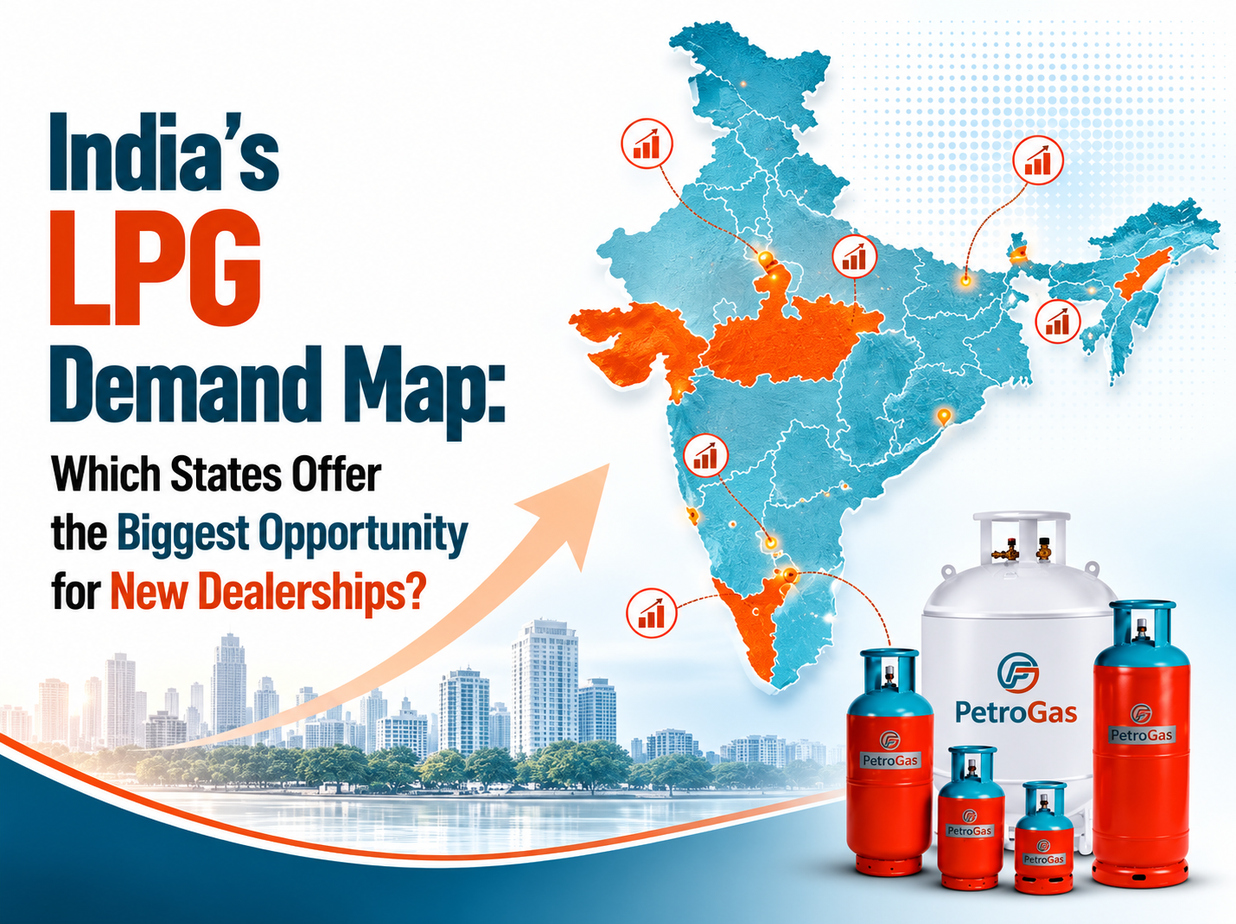
India’s LPG Demand Map: Which States Offer the Biggest Opportunity for New Dealerships?
India’s LPG market continues to expand, supported by a large domestic customer base, rising household energy demand and the continued use of LPG across urban and rural areas. However, the opportunity is not equally distributed across every state. Understanding LPG demand by state in India can help prospective investors identify markets where customer volumes, consumption patterns and distribution requirements create stronger business potential.
Recent government data shows that India had more than 32 crore active domestic LPG customers, while total LPG consumption reached about 31.17 million tonnes in FY 2024–25. For anyone considering LPG dealership in India, the right location therefore requires more than simply choosing a populous state. Customer density, refill frequency, existing distributors, infrastructure and local growth should all be evaluated.
Understanding LPG Demand by State in India
LPG demand by state in India varies significantly because states differ in population, urbanisation, household income, LPG penetration and dependence on alternative cooking fuels.
According to PPAC data, some of the largest LPG customer bases are found in Uttar Pradesh, Maharashtra, West Bengal, Tamil Nadu, Bihar and Karnataka. Uttar Pradesh alone accounted for around 15% of India's LPG customers in data reported for December 2025.
This makes large states particularly interesting for investors, but a large customer base does not automatically mean an open dealership opportunity. Existing distributor coverage and the specific location advertised by an oil marketing company remain important.
States Showing Strong LPG Market Potential
When studying LPG consumption in different states, investors should look at both absolute demand and the scope for additional distribution.
| State/Region | Why It Matters for LPG Dealership Opportunities |
|---|---|
| Uttar Pradesh | Very large customer base and extensive rural and urban markets |
| Maharashtra | High number of customers and strong urban consumption |
| West Bengal | Large household base and significant LPG usage |
| Tamil Nadu | Strong domestic demand and established LPG adoption |
| Bihar | Large population with substantial PMUY customer coverage |
| Karnataka | Large consumer base and growing urban demand |
| Rajasthan | Wide geographic market with significant rural demand |
| Madhya Pradesh | Large territory and substantial household customer base |
These states should not be viewed as guaranteed dealership locations. Instead, they can serve as starting points for deeper market research.
LPG Consumption in Different States: What the Numbers Tell You
The regional pattern is also important. In Apr–Dec 2024, the northern region accounted for about 31% of packed domestic LPG sales by PSU oil marketing companies, followed by the southern region at 27%, western region at 22%, eastern region at 17% and north-eastern region at 3%.
At the same time, per-connection consumption differs considerably. For FY 2024–25, non-PMUY consumers in states such as Delhi, Haryana and Punjab recorded higher annual consumption than several states with larger PMUY populations.
This distinction matters because LPG dealership opportunities in India should be assessed using both customer numbers and refill behaviour.
Why State-Wise LPG Penetration Matters
A state with millions of LPG connections can provide a substantial customer pool, but high penetration may also mean that the market is already well served.
On the other hand, areas with growing LPG adoption may offer room for distribution expansion.
Investors should examine:
• Number of active domestic LPG customers
• PMUY and non-PMUY customer mix
• Average LPG consumption per connection
• Population and household growth
• Urban and rural customer distribution
• Number of existing distributors
• Distance between distributors and customers
• Road connectivity and delivery accessibility
• Availability of suitable godown and showroom locations
PPAC publishes state-wise data on active domestic customers and PMUY connections, making these useful starting points for market research.
LPG Dealership by State: Look Beyond the State Name
The real opportunity is often at the district, town or cluster level rather than the state level. A high-demand state may have saturated distribution in major cities while smaller towns or developing rural clusters may have different requirements.
The official selection process also matters. IndianOil states that new LPG distributors are appointed based on feasibility studies and marketing plans, followed by advertisements inviting eligible applicants. Selection is conducted according to applicable guidelines, including a draw among eligible applicants where prescribed.
Therefore, investors should monitor official advertisements rather than assuming that a high-demand state automatically has an available dealership.
How to Evaluate an LPG Dealership Opportunity
Before investing, create a simple location scorecard covering:
1. Demand: Estimate the existing and potential LPG customer base.
2. Competition: Identify nearby distributors and their service areas.
3. Consumption: Compare refill frequency and per-connection consumption.
4. Infrastructure: Assess roads, transport access, godown feasibility and delivery routes.
5. Growth: Study new housing, population growth and commercial development.
6. Official availability: Check whether the location is actually included in an authorised distributorship advertisement.
This approach gives a more realistic picture of potential than looking at state population alone.
The Future of LPG Distribution in India
The LPG distribution network in India is becoming increasingly data-driven, with customer coverage extending across metropolitan areas, smaller towns and rural regions. Total LPG consumption grew by 5.1% in FY 2024–25, reaching approximately 31.17 million tonnes, according to PPAC.
For prospective investors, this indicates that LPG remains an important household energy market. Yet the strongest opportunity may come from identifying underserved or strategically located markets rather than simply entering the biggest state.
Conclusion
The map of LPG demand by state in India shows that Uttar Pradesh, Maharashtra, West Bengal, Tamil Nadu, Bihar, Karnataka and other large markets deserve close attention. However, successful LPG dealership in India depends on more than overall state demand. Customer density, consumption, competition, infrastructure and official dealership availability must be considered together.
If you are evaluating LPG dealership opportunities in India, Petro Gas can help you understand the factors that should be considered before selecting a market. Study the numbers, compare locations and make your investment decision based on actual local potential.
FAQs
1. Which states in India have the highest LPG consumption?
Large states such as Uttar Pradesh, Maharashtra, West Bengal, Tamil Nadu, Bihar and Karnataka have substantial LPG customer bases and therefore represent major LPG markets. However, total consumption and per-household consumption can vary between states.
2. Which states have the fastest-growing LPG demand?
Growth can differ by customer segment and period. States with expanding household coverage, increasing LPG adoption and growing urban or rural populations can offer strong potential. Investors should compare recent PPAC consumption and customer data rather than relying on a fixed ranking.
3. How does state-wise LPG penetration affect dealership opportunities?
High penetration means a large established customer base but may also indicate stronger distributor coverage. Lower or rapidly increasing penetration can signal emerging demand. The ideal opportunity depends on the specific location and existing distribution network.
4. What data should investors analyse before selecting an LPG dealership location?
Investors should study active customers, PMUY connections, consumption per connection, refill patterns, population growth, existing distributors, road connectivity, delivery distance and official dealership advertisements.
5. Is a high-demand state automatically the best location for an LPG dealership?
No. State-level demand is only an initial indicator. A specific district or town may offer better potential because of customer growth, lower distributor density, better logistics or an officially advertised dealership location